Research Article | | Peer-Reviewed

Nutritional Profile Analysis of Red Bean Tempeh Fermented Using Rhizopus Oligosporus at Different Time

Received: 28 August 2024     Accepted: 14 September 2024     Published: 29 September 2024
Views:       Downloads:
Abstract

Investigation of non-soybean legumes as raw material for making tempeh is very important to be carried out continuously considering soybean production tends to decline from year to year. This study aims to analyse the potential of red bean seeds as raw material for tempeh and changes in their nutritional profile when fermented at different fermentation times. The red beans were soaked in water overnight at room temperature and then boiled for 20 minutes. After boiling, the red beans were drained and then fermented for 36, 48, and 60 hours using a suspension of Rhizopus oligosporus with a weight of 2 g for each 1000 g of red beans. Red bean tempeh was analysed for quality using test parameters including physical appearance (color, texture, and aroma) and nutritional profile (calorie value, ash, water, crude fiber, fat, protein, and carbohydrate content). The physical appearance and nutritional profile of red bean tempeh were compared with those of soybean tempeh, while the quality of tempeh was compared with Indonesian national standards for tempeh. The results showed that the length of fermentation time significantly affected the nutritional profile of tempeh. Red bean tempeh fermented for 48 hours had a nutritional profile including energy, water, ash, protein, fat, carbohydrate, and crude fiber content of 201.59 kcal/100 g tempeh, 61.97%, 1.18%, 16.19%, 10.98%, 8.29%, and 1.13%, respectively. The physical appearance and nutritional profile of red bean tempeh have met the tempeh quality requirements issued by the Indonesian national standard for tempeh. Therefore, red bean seed appears to be as good as raw materials for tempeh production.

Published in International Journal of Nutrition and Food Sciences (Volume 13, Issue 5)
DOI 10.11648/j.ijnfs.20241305.15
Page(s) 199-208
Creative Commons

This is an Open Access article, distributed under the terms of the Creative Commons Attribution 4.0 International License (http://creativecommons.org/licenses/by/4.0/), which permits unrestricted use, distribution and reproduction in any medium or format, provided the original work is properly cited.

Copyright

Copyright © The Author(s), 2024. Published by Science Publishing Group

Keywords

Fermentation Time, Indonesian National Standard, Nutritional Profile, Red Bean Tempeh, Rhizopus Oligosporus

1. Introduction
Tempeh is a healthy and inexpensive source of functional protein made from solid-state fermented legumes with food-grade molds from the genera of Rhizopus, such as Rhizopus oligosporus and Rhizopus oryzae. These molds produce various enzymes such as amylase, lipase, and protease, which can hydrolyse carbohydrates, fats, and proteins from beans into simple compounds such as glucose, fatty acids, and alpha amino acids, which are more easily digestible nutrients . In addition, tempeh can be a favorite food source because it is affordable and is a source of proteins, fats, vitamins, minerals , and phenolic compounds . The United States Department of Agriculture Standard Reference (USDA SR) legacy foods database states that tempeh has 1920 kcal/kg, with 20.3% protein, 10.8 %, and 7.64% carbohydrates .
Legumes plants belong to the family of Leguminosae, which are sources of protein, carbohydrates, and minerals including iron, magnesium, manganese, zinc, and phosphorus . In Indonesia, there are various types of legume varieties, such as red beans, mung beans, black beans, peanuts, fava beans, and soybeans. Among all legumes, soybean is the most widely used as a raw material for making tempeh, soymilk, tofu, and soy sauce because of its high nutritional content, including protein, fiber, carbohydrates, phenolic compounds, and essential minerals such as calcium, magnesium, iron, sodium, zinc, and phosphorus . Soybean typically contains approximately 37.69% protein, 28.2% crude fat, 5.44% crude fiber, and about 8.07% moisture based on the dry weight of mature raw seeds . Phytochemical compound analysis of soybean tempeh from Indonesia found that it contained 20.8% protein, 13.5% carbohydrate, and 8.8% fat .
Currently, world soybean production continues to decline, while soybean consumption is projected to continue increasing in the coming years with population growth annually. In Indonesia, soybeans are widely processed for various high-protein food products such as tempeh, soy milk, tofu, tauco, oncom, soy sauce, ice cream, cooking oil, and soybean flour. It is estimated that around 50% of soybeans are consumed in the form of tempeh, 40% as tofu, and 10% as other products such as soy sauce, tauco, and oncom . Indonesia imports around 2,576,619 tons of soybeans every year to meet the need for soybeans, which continues to increase every year. Meanwhile, the availability of local soybeans is insufficient because soybean production tends to decline . Therefore, it is important to investigate non-soy legumes as a raw material for making tempeh. Various non-soy legumes including mung beans and red beans , chickpeas, lentils, white beans, black beans , faba beans , cacao beans , cowpea beans and koro beans have been investigated as substitute substrates for soybeans in making tempeh. Among non-soybeans, a red bean is considered a functional food that provides health benefits and has therapeutic properties. A red bean is a nutritional source of vegetable protein, carbohydrates, vitamins, and minerals. The nutritional profile of these beans comprises 22.7% protein, 3.5% minerals, 1% fat, 57.7% carbohydrates , and minerals such as calcium and potassium, with content ranging from 785 to 9338.5 mg/kg and 5651.7 to 9129.9 mg/kg dry matter, respectively. Iron and zinc contents ranged from 18.9 to 41.9 mg/kg and 21.0 to 51.5 mg/kg dry matter, respectively. These minerals play an important role in controlling blood pressure . Apart from that, red beans also contain phenolics and flavonoids of 35.5 mg/g extract and 4.81 mg/g extract, respectively . The use of red beans for making tempeh is still limited, even though they are quite abundant and their nutritional profile is very promising.
Tempeh is usually produced by home industries on a small scale with less controlled fermentation, whereas nutritional changes occur during the fermentation process. The usual method for producing tempeh includes rinsing, immersing in water, removing hulls, boiling, adding tempeh starter, wrapping, and fermentation. Throughout the incubation process, molds fermentation results in the breakdown of lipids and proteins, leading to higher levels of free fatty acids and amino acids while reducing carbohydrate content. In addition, fermentation time affects the quality of fermented products due to changes in chemical composition and physical properties during fermentation. Moreover, the quality and safety of tempeh for consumption are affected by the fermentation duration, and excessive fermentation time causes a decrease in quality and potential spoilage . Therefore, optimizing fermentation duration is very important to enhance the nutritional quality, aroma, texture, and safety of tempeh.
This study aimed to evaluate the effect of fermentation time on the physical appearances such as color, texture, and aroma, as well as the nutritional profile involving energy, ash, water, crude fiber, protein, fat, and carbohydrate content of tempeh prepared from red beans fermented with Rhizopus oligosporus. The fermentation time of 36, 48, and 60 hours were selected, considering the time commonly used for making tempeh is approximately 2–3 days. The red bean tempeh fermented at various times was analysed for its physical appearance and nutritional profile, and then the results were compared with soybean tempeh and the standard quality requirements for tempeh set by the Indonesian National Standard (SNI) 1344: 2015 for tempeh .
2. Materials and Methods
2.1. Materials
The Rhizopus oligosporus used in this research was obtained from the research centre of the Bandung Institute of Technology. The tempeh starter brand is Raprima, which is produced by PT. Aneka Fermentasi Indonesia, Bandung, Indonesia. Raprima tempeh starter contains Rhizopus oligosporus.
2.2. Sample Collection
The sample of red beans and soybean seeds for tempeh preparation were obtained from the Buleleng traditional market in Bali, Indonesia.
2.3. Preparation of Beans Tempeh
A total of 6000 g of red beans and soybeans were washed and soaked overnight and at room temperature, and then boiled using water in a ratio of 1: 3 (beans to water) for 20 minutes. The beans were drained, then cooled until they reached room temperature, and furthermore fermented using Rhizopus oligosporus starter. To investigate the effect of fermentation time on physical properties and nutrient content, the tempeh was prepared with different fermentation times, namely 36, 48, and 60 hours. The composition of raw materials for tempeh preparation is presented in Table 1.
Table 1. Composition of raw materials of tempeh.

Tempeh

Beans (g)

Rhizopus oligosporus (g)

Fermentation time (hour)

Red bean tempeh

1

1000

2

36

2

1000

2

48

3

1000

2

60

Soybean tempeh

1

1000

2

36

2

1000

2

48

3

1000

2

60

2.4. Physical and Nutritional Profile of Tempeh
2.4.1. Physical Appearance of Tempeh
The physical appearance of red bean tempeh and soybean tempeh fermented at various times was observed its color, texture, and aroma. The physical performance was compared to the standard quality requirements for tempeh set by the Indonesian National Standard (SNI) 1344: 2015 for tempeh.
2.4.2. Nutritional Profile of Tempeh
(i). Determination of Ash Content
The ash content (A. C) of tempeh was determined using the dry method. A total of 0.5 g of sample was put into a silica cup and heated in a furnace at 600°C for 2 hours until it turned white. The crucible was cooled in a desiccator and weighed. Ash content is calculated using the formula:
A. C %=Ash weight gTempeh sample weight g x 100%
(ii). Determination of Water Content
The water content (WC) of tempeh is determined using a method according to SNI 3144: 2015. A total of 2 g of tempeh sample was put into a porcelain cup and then weighed. The porcelain cup containing the tempeh sample was heated at 100°C for 5 hours, then cooled in a desiccator for 30 minutes and immediately weighed. Heating and weighing were repeatedly done until the sample weight was relatively constant. The water content was calculated by the formula:
W C. %=W1-W2W1-Wox100%
Where Wo is the weight empty porcelain cup, w1 and w2 are the weight porcelain cup with a tempeh sample at before and after heating.
(iii). Determination of Crude Fiber Content
The crude fiber content (CFC) of tempeh was determined using the AOAC 1995 official method for crude fiber . A total of 10 g of red bean tempeh was put into a 500 mL Erlenmeyer flask and added. Samples were digested at 105°C with 200 mL of H2SO4 solution with a concentration of 0.325 N for 15 minutes, and then digested again with 200 mL of 1.25 N NaOH solutions. The fat was filtered using Whatman filter paper 42 and successively washed with warm water, 0.325 N H2SO4, and finally using alcohol. The filter paper is dried in an oven at 103°C until it has a constant weight. The fiber content is calculated using the formula:
CFC %=A-BCx100%
Where A is the weight filter paper containing fiber (g), B is the empty weight of filter paper (g), and C is the weight of sample.
(iv). Determination of Fat Content
The fat content (FC) in the tempeh sample was determined using the method issued by SNI 3144: 2015. A total of 5 g of tempeh sample was placed in a 250 mL beaker, and then added to 45 mL of boiling distilled water while stirring until homogeneous. A volume of 55 mL of 8 M HCl solution was added to the mixture, then covered using a watch glass, and then slowly boiled for 15 minutes. The precipitate was filtered using Whatman filter paper No. 42 and dried at 100°C for 6 hours. The precipitate in the filter paper was extracted by the Soxhlet extraction method with petroleum ether as a solvent. The petroleum ether extract obtained was then evaporated to dryness in an aluminium cup, and the fat was calculated by gravimetrically.
FC %=W1-WoWx100%
Where w is the tempeh sample weight (g), wo and w1 are the weight of the empty aluminium cup and aluminium cup with fat residues (g), respectively.
(v). Determination of Total Protein Content
The total protein content (TPC) in the tempeh sample was analysed using the Kjeldahl method by SNI 3144: 2015. A total of 1.0 g of tempeh sample was digested in a digestion tube, added with 0.05 g of CuSO4.5H2O as a catalyst, 5 grains of anti-bumping ceramic, and 25 ml of conc. H2SO4. The mixture was digested at 110°C for one hour, then removed from the tube and allowed to stand until the sample was cooled. The digested sample was diluted cautiously with 50 mL of distilled water. and was transferred into a 250 mL conical flask, adding 25 mL of 4% boric acid, 75 mL of 30% NaOH, and finally connected for distillation. Place a conical flask containing ammonia distillate on a magnetic stirrer and add methyl red as an indicator. A total of 10 mL sample was titrated with standard 0.1 N hydrochloric acid until the solution color changed from green to pinkish. The percentage of protein was calculated using the formula:
T P C %=b-a N HCl x 14 x 6.25Wx100%
Where a is volume of 0.1 N HCl used in blank titration (mL), b is volume of 0.1 N HCl used in sample titration (mL) and W is the weight of the red bean tempeh sample (g).
2.5. Statistical Analysis
The results of research were expressed as the mean±standard deviation. The effect of fermentation duration on the nutrient content of tempeh was statistically analysed using a One-way Analysis of Variance (ANOVA) at a 95% confidence level (p<0.05), followed by a post hoc test (Tukey’s test) in IBM SPSS Statistics software version 24.
3. Results and Discussion
3.1. Physical Appearance of Tempeh
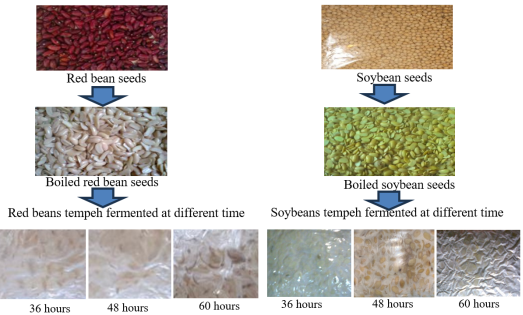
The red bean tempeh preparation was started by washing the red bean seeds, followed by boiling for 20 minutes, soaking overnight, steaming, packing in plastic bags, and fermenting using Rhizopus oligosporus at different times of 36-60 hours. The physical appearance of red bean tempeh prepared under different fermentation times is presented in Figure 1, while the observation result of color, texture, and compactness is shown in Table 2.
Figure 1. Physical appearance of red bean and soybeans tempeh under different fermentation time.
Table 2. The physical appearance of red bean tempeh and requirements quality of tempeh according to SNI 3144: 2015.

Test criteria

Observation results of physical performance of red beans and soybeans tempeh at different fermentation times (h)

Requirements

36

48

60

Color Red beans tempeh

Thin white

White color evenly and rather thick

Brownish-white color

White evenly throughout the surface

Soybeans tempeh

Phale white

White color evenly and rather thick

Brownish color

Texture Red beans tempeh

Less compact, when sliced surface uneven slices

Compact, when sliced surface even slices

Compact, when sliced surface even slices

Compact, when sliced whole (not easy to fall off)

Soybeans tempeh

Less compact

Compact, when sliced surface even slices

Compact, when sliced surface even slices

Aroma Red beans tempeh

Typical smell of weak tempeh

Typical smell of tempeh without ammonia smell

Typical smell of tempeh without ammonia smell

The typical smell of tempeh has no ammonia smell

Soybeans tempeh

Typical smell of weak tempeh

Typical smell of tempeh without ammonia smell

Typical smell of tempeh without ammonia smell

As we can see in Table 2, the sensory analysis showed that the color, texture and aroma of red bean tempeh and soybean tempeh were almost the similar. The physical appearance of fermented red beans tempeh for 48 ang 60 hours using Rhizopus oligosporus already meets the tempeh quality requirements issued by SNI 3144: 2015 for tempeh.
3.2. Nutritional Profile of Tempeh
The duration of fermentation and the weight of fungus used in the making tempeh process are two important factors that influence the nutritional content of tempeh. The response of fermentation time to the energy, ash, water, crude fiber, fat and crude protein of tempeh were evaluated and compared to the nutritional standard value requirements of tempeh issued by SNI 3144: 2015. The nutritional profiles of tempeh are presented in Table 3.
Fermentation duration plays an important role in optimizing the nutritional profile of tempeh. Different studies point out the impact of fermentation time on the nutritional content of tempeh. The nutrient content such as protein, fat, carbohydrate, water and ash of tempeh can vary based on the fermentation time. Table 3 shows data on energy, ash, water, and crude fiber content in red bean and soybean tempeh prepared at different length of fermentation time. The energy content of both tempeh decreases with the increased time fermentation. Even though the calories in red bean tempeh are lower than soybean tempeh, the calories are still higher than the calories set by the USDA, namely 1990 kcal/kg of tempeh.
Table 3. The nutrient content of red beans and soybeans tempeh as well as the quality requirements of tempeh according to SNI 3144: 2015.

Test criteria

Fermentation time (h)

Requirements

36

48

60

Red bean tempeh

Energy (kcal/100 g)

205.35±2.25

201.59±0.66

199.45±0.56

-

Ash content (%)

1.09±0.01

1.18±0.02

1.25±0.04

-

Water content (%)

61.89±0.03

61.97±0.01

62.09±0.02

Max. 65

Crude fiber content (%)

1.02±0.05

1.13±0.07

1.17±0.07

Max. 2.5

Fat content (%)

11,2±0.15

10.98±0.08

10.87±0.08

Min. 7

Crude protein

15.75±0.07

16.19±0.16

16.37±0.09

Min. 15

Soybean tempeh

Energy (kcall/100 g)

218.01±0.99

217.53±0.68

211.75±1.76

-

Ash content (%)

1.76±0.07

1.93±0.05

2.01±0.04

-

Water content (%)

56.89±0.17

57.01±0.03

58.99±0.37

Max. 65

Crude fiber content (%)

1.50±0.08

1.75±0.04

1.89±0.02

Max. 2.5

Fat content (%)

8.90±0.28

8.78±0.13

8.65±0.09

Min. 7

Crude protein

21.54±0.03

21.78±0.06

21.90±0.13

Min. 15

Ash content indicates the presence of minerals from the combustion of organic materials. The higher the ash content, the higher the level of minerals in food. The results of variance analysis showed that the duration of fermentation time has a significant effect on the ash content of tempeh (p<0.05). As shown in Table 3, fermentation duration contributed to the ash content of both tempeh, where the ash content increased with the increasing fermentation time. The increase in ash content after 60 hours of tempeh fermentation compared to 36 hours may be due to the accumulation of minerals in the tempeh during fermentation. According to Dewi et al. (2014), the increase in tempeh ash content as fermentation time increases is possibly caused by the formation of vitamin B12 during the fermentation process, where vitamin B12 is a cobalamin compound containing the mineral Cobalt, which causes an increase in the ash content in tempeh . The vitamin B12 content in soybeans is 3.6 mg/kg of soybeans, while the soybean tempeh fermented using Rhizopus oligosporus have a vitamin B12 content of 28.8 mg/kg of tempeh . The increase ash content in tempeh may also occur due to the production of enzymes such as lipase, protease, and phytase by Rhizopus oligosporus during the fermentation process to hydrolyse the carbohydrates, lipids, and proteins from soybeans to produce fatty acids and amino acids. Enzymes are proteins containing the mineral element nitrogen, which is calculated as ash . This finding is consistent with Vital et al. (2018) and Ishartani et al. (2021), who reported that the ash content of soybean tempeh fermented using Rhizopus oligosporus increased with increasing fermentation time .
The duration of fermentation affects the water content of tempeh. As shown in Table 3, red bean tempeh fermented for 36, 48, and 60 hours produced water contents of 61.89%, 61.97%, and 62.09%, respectively. Meanwhile, the water content for soybean tempeh at the same condition treatment was found to be 56.89%, 57.01%, and 58.99%, respectively. The results of the variance analysis showed that the fermentation time had a significant effect on the water content of tempeh (p<0.05). The water content of tempeh increases as the fermentation time increases, which may be related to the formation of water as a result of the decomposition of macromolecules into simpler compounds by moulds during the fermentation process42. The increase in water content of tempeh with the length of fermentation was also found in the preparation of tempeh edamame. Tempeh edamame fermented at 36 hours and 48 hours consisted water content was 33.30% and 37.81%, respectively . The water content of tempeh made from red beans and soybeans in all fermentation treatments fully meets the water content standard issued by SNI 3144: 2015, namely the maximum water content (w/w) of 65% and the USDA recommendation of 59.65%. This indicates that red bean is a suitable non-soy legume as a raw material to replace soybean for tempeh preparation.
Fiber plays an important role in facilitating the digestive tract, regulating the immune system, and preventing various diseases such as obesity, diabetes, hypertension, and cancer . Crude fiber is a part of carbohydrates and lignin that is relatively difficult to digest . In this research was found the increase the crude fiber content, the decrease in energy content of tempeh. Similar results were also found in research by Gutema and Solesa (2024), who reported that bole raw and kanketi raw with crude fiber content of 4.71% and 6.60% contained energy of 3368.9 and 3297.2 kcal/kg, respectively . An analysis of variance on the effect of fermentation time on the crude fiber content of tempeh showed that the fermentation time had a significant effect on the crude fiber content of tempeh (p<0.05). The prolonging of the fermentation time resulted in an increase in the crude fiber content of tempeh. This is maybe due to the more mycelium of Rhizopus oligosporus containing polysaccharide compounds. The crude fiber content of red bean tempeh and soybean tempeh varied between 1.02-1.17% and 1.50-1.89%, respectively. According to SNI 3144: 2015 regarding tempeh, it is stated that the crude fiber content in tempeh is a maximum of 2.5%. This indicates that red beans are suitable as raw materials for tempeh.
Fat plays a role in regulating the texture and taste of tempeh. The lipolytic enzymes produced by Rhizopus hydrolyse fats into fatty acids such as palmitic, stearic, oleic, linolenic and linoleic which are beneficial for health. The fat content of tempeh made with the addition of 2 g of Rhizopus oligosporus powder per 1000 g of red beans and soybean at fermentation time of 36 hours were 11.20% and 8.90%, respectively. The fat content of both tempeh tends to decrease with increasing fermentation time. After 48 h of incubation, the fat content becomes 10.98% (red bean tempeh) and 8.78% (soybean tempeh) and then reaches 10.87% (red bean tempeh) and 8.65% (soybean tempeh) at the time of fermentation 60 hours. The findings indicated a significant difference (p<0.05) in the fat content of tempeh prepared with the different lengths of fermentation time. The fat content in tempeh did not decrease significantly when the fermentation time was 36 to 48 hours, but it experienced a significant decrease when the fermentation time was 60 hours. The decrease in fat content may be attributed to the breakdown of fat and triacylglycerol by lipase enzymes during fermentation. This action resulted in a change in the aroma, taste, odor, and texture of fermented products .
3.3. The Effect of Fermentation Time on Protein Content
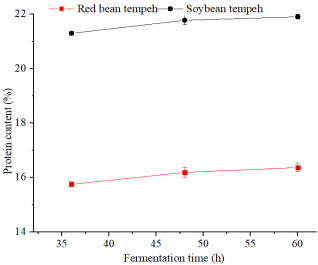
Variation of fermentation time was carried out from 36 to 60 hours which was intended to determine the length of the fermentation process to produce the best tempeh nutritional profile. The protein content of fermented red bean and soybean tempeh at different fermentation time was showed in Figure 2.
Figure 2. The changes in protein content during the fermentation times of tempeh.
It can be seen clearly in Figure 2, the protein content of both tempeh fermented with Rhizopus oligosporus tends to increase with the longer fermentation time. At the fermentation time of 36, 48, and 60 hours, the protein content in red bean tempeh was 15.75%, 16.19%, and 16.37%, while in soybean tempeh it was found to be 21.30%, 21.78%, and 21.91%, respectively. The results of the variance analysis showed that fermentation times of 36 hours and 40 hours produced significantly different protein contents in tempeh, however, there was an insignificant increase in protein content at fermentation times of 48 and 60 hours. The results of this research indicate that the optimum time for tempeh fermentation is 48 hours. This is in agreement with Jan et al. (2022) who stated an increase in protein content as the fermentation duration . The increase in protein content may be related to the increase in Rhizopus oligosporus mycelium with a longer fermentation time . The red beans tempeh was met to quality requirements for tempeh according to the Indonesian National Standard for tempeh (SNI) 3144: 2015, the minimum protein content in tempeh is 15%, w/w.
3.4. The Effect of Fermentation Time on Carbohydrate Content
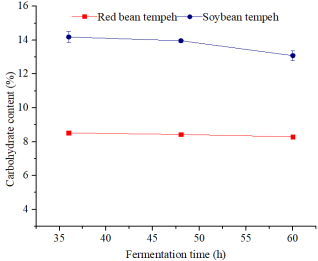
The presence of digestive enzymes produced by moulds during the fermentation process causes carbohydrates in tempeh to be easier to digest. The changes in carbohydrates during the fermentation of tempeh prepared using red bean and soybean with the addition of 2 g Rhizopus oligosporus were presented in Figure 3.
Figure 3 shows that longer fermentation of tempeh results in a carbohydrate content that tends to decrease. The results of the variance analysis showed that the length of fermentation time had a significant effect on the carbohydrate content of tempeh (p<0.05). The carbohydrate content of tempeh with a fermentation time of 36 to 60 hours was observed to decrease from 8.52% to 8.29% for red bean tempeh and 14.19% to 13.09% for soybean tempeh. The decrease in carbohydrate content in both tempeh during fermentation at 36 and 48 hours was not significantly different, but a significant difference was observed at the 60 hours fermentation. Based on these findings, it seems that 48 hours is the best fermentation time for producing tempeh. The decrease in the carbohydrate content of fermented beans with increasing fermentation time is caused by the activity of microorganisms that convert carbohydrates into energy for cultivation and other cellular action during fermentation . The result of this research was consistent with finding research of Tan et al. (2024), who also found that the longer fermentation time of tempeh was able to decrease the carbohydrate content due to the carbohydrates were consumed by moulds during fermentation process.
4. Conclusions
The nutritional profiles of red bean and soybean tempeh were significantly influenced by the length of fermentation time. Tempeh, which is produced by fermenting red beans for 48 hours and adding 2 grams of Rhizopus oligosporus per 1000 g of beans, contains 201.59 kcal, 61.97% water, 1.18% ash, 16.19% protein, 10.98% fat, 8.29% carbs, and 1.13% crude fiber. The physical appearance and nutritional profile value of red bean tempeh meet the tempeh quality requirements issued by SNI 3144: 2015. It seems that 48 hours of fermentation time is enough to make tempeh from red beans. Therefore, red bean seed appears to be as good as raw materials for tempeh production. To obtain more adequate nutritional profile information, analysis of other nutrients such as flavonoids, phenolic compounds, and minerals contained in red bean tempeh is needed. Besides that, it is suggested for future research to investigate local non-soybean legumes to expand the diversity of tempeh raw material sources.
Abbreviations

AC

Ash Content

AOAC

Association of Official Analytical Chemists

CuSO4.5H2O

Copper (II) Sulfate Pentahydrate

NaOH

Sodium Hydroxide

H2SO4

Sulphuric Acid

HCl

Hydrochloric Acid

WC

Water Content

CFC

Crude Fiber Content

FC

Fat Content

TPC

Total Protein Content

USDA SR

United States Department of Agriculture Standard Reference

SNI

Indonesian National Standard

Acknowledgments
The authors would like to thank the laboratory staff of the Chemistry Department, Universitas Pendidikan Ganesha for laboratory facilities and services during the research data collection.
Author Contributions
Siti Maryam: Conceptualization, Data curation, Formal Analysis, Funding acquisition, Investigation, Methodology, Project administration, Writing – original draft
I Dewa Ketut Sastrawidana: Resources, Software, Visualization, Writing – review & editing
I Ketut Sudiana: Resources, Writing – review & editing
I Nyoman Sukarta: Formal Analysis, Software, Visualization, Writing – review & editing
Funding
The research is funded by Universitas Pendidikan Ganesha, Bali, Indonesia with contract number of 69/UN48.15/LT/2022.

Conflicts of Interest
The authors declare no conflicts of interest.
References
[1] Dwiatmaka, Y., Yuniarti, N., Lukitaningsih, E., Wahyuono, S. Fermentation of soybean seeds using Rhizopus oligosporus for tempeh production and standardization based on flavones content, International Journal of Applied Pharmaceutics. 2022, 14(6), 131-136.
[2] Yarlina, V. P., Nabilah, F., Djali, M., Andoyo, R., Lani, M. N. Mold characterization in "RAPRIMA" tempeh yeast from LIPI and over fermented Koro Pedang (Jack Beans) tempeh. Food Research. 2023, 7(1), 125-132.
[3] Tahir, A., Anwar, M., Mubeen, A., Raza, S. Evaluation of physicochemical and nutritional contents in soybean fermented food tempeh by Rhizopus oligosporus. Journal of Advances in Biology and Biotechnology. 2018, 17(1): 1-9.
[4] Boniglia, C., Carratu, `B., Gargiulo, R., Giammarioli, S., Mosca, M., Sanzini, E. Content of phytoestrogens in soy-based dietary supplements. Food Chemistry. 2019, 115(4), 1389–1392.
[5] Kameda, T., Aoki, H., Yanaka, N., Kumrungsee, T., Kato, N. Production of isoflavone aglycone-enriched tempeh with Rhizopus stolonifera. Food Science and Technology Research. 2018, 24(3), 493‒499.
[6] Afifah, D. N., Rahma, A., Nuryandari, S. S., Alviche, L., Hartono, P. I., Kurniawati, D. M., Wijayanti, H. S., Fitranti, D. Y., Purwanti, R. J. Nutrition content, protein quality, and antioxidant activity of various tempeh gembus preparations Journal of Food and Nutrition Research. 2018, 7(8), 605-612.
[7] Lo, D., Romulo, A., Lin, J. Y., Wang, Y. T., Wijaya T. H., Wu, M. C. Effect of different fermentation conditions on antioxidant capacity and isoflavones content of soy tempeh. AIMS Agriculture and Food. 2022, 7(3), 567–579.
[8] U. S. Department of Agriculture, Agricultural Research Service. Food Data Central, 2019. Available at:
[9] Li, Z., Li, J., Mo, B., Hu, C., Liu, H., Qi, H., Wang, X., Xu, J. Genistein induces cell apoptosis in MDA-MB-231 breast cancer cells via the mitogen-activated protein kinase pathway. Toxicology in Vitro. 2008, 22(7), 1749-53.
[10] Bolarinwa, I. F., Al-Ezzi, M. F. A., Carew, E., Muhammad, K. Nutritional value of legumes in relation to human health: A review. Advance Journal of Food Science and Technology. 2019, 17(5), 72-85.
[11] Mullins, A. P., Arjmandi, B. H. Health benefits of plant-based nutrition: Focus on beans in cardiometabolic diseases. Nutrients. 2021, 13(2), 519.
[12] Etiosa, O. R., Chika, N. B., Benedicta, A. Mineral and proximate composition of soya bean. Asian Journal of Physical and Chemical Sciences. 2017, 4(3), 1-6.
[13] Afifah, D. N., Sari, I. R., Prastifani, N. T., Fulyani, F., Anjani, G., Widyastuti, N., Hastuti, V. N. Effect of fermentation time on nutrition content, physical properties, pH, amino acids, fatty acids composition and organoleptic on fermented mackerel sausage (Rastrelliger kanagurta Cuvier) characteristics. International Journal of Food Studies. 2023, 12, 57-70.
[14] Baroh, I., Windiana, L., Shodiq, W. M., Khan, W. A. Analysis of soybean production trends in Indonesia. BIO Web of Conferences. 2024, 104, 00020.
[15] Sibuea, F. A., Sibuea, M. B., Safitri, S. A. Indonesian soybean import in international trade. Journal of Management and Agriculture. 2024, 21(1), 122-131
[16] Abu-Salem, F. M., Mohamed, R. K., Gibriel, A. Y., Rasmy, N. M. H. Levels of some antinutritional factors in tempeh produced from some legumes and jojobas seeds. International Journal of Nutrition and Food Engineering. 2014, 8(3), 296-301.
[17] Erkan, S. B., Gurler, H. N., Bilgin, D. G., Germec, M., Turhan, I. Production and characterization of tempeh from different sources of legume by Rhizopus oligosporus. Journal of Food Science and Technology. 2020, 119, 11-25.
[18] Polanowska, K., Grygier, A., Kuligowski, M., Rudzińska, M., Nowak, J. Effect of tempeh fermentation by three different strains of Rhizopus oligosporus on nutritional characteristics of faba beans. LWT- Food Science and Technology. 2020, 122, 1-9.
[19] Wahyudi, M., Tjahyadi, A. L., Erawati, C. M., Sukweenadhi, J. Flour made from cacao-soybean tempeh fermented using soybean tempeh inoculum. Food Science and Technology. 2023, 43, e18423.
[20] Adhianata, H., Pramana, A., Rochmawati, N., Ditya, Y. The 4th International Conference on Sustainability Agriculture and Biosystem. IOP Conf. Series: Earth and Environmental Science. 2022, 1059, 012062.
[21] Qayyum, M. M. N., Butt, M. S., Anjum, F. M. Composition analysis of some selected legumes for protein isolates recovery. Journal of Animal and Plant Sciences. 2012, 22(4), 1156-1162.
[22] Mananga, M. J., Didier, K. B., Charles, K. T., Fadimatou, B., Ruth, D. N., Gilbert, M. M., Blaise, K., Michelle, D., Elie, F., Marie, K. S. Nutritional and antinutritional characteristics of ten red bean cultivars (Phaseolus vulgaris L.) from Cameroon. International Journal of Biochemistry Research and Review. 2021, 30(4), 1-14.
[23] Khatun, S., Kim, T. Phenolic compound, antioxidant activity and nutritional components of five legume seed. American Journal of Biomedical Science and Research. 2021, 12(4), 32-334.
[24] SNI 3144: 2015. Indonesia National Standard: Requirements for the standard quality of soybean tempeh
[25] AOAC Official Method 978.10, Fiber crude) in animal feed and pet food. Official Methods of Analysis of AOAC International, 18th edition. 2005, Chapter 4, pp. 46-47, AOAC International, Gaithersburg.
[26] Dewi, I. W. R., Anam, C., Widowati, E. Sensory characteristic, nutrient value and antioxidant activities of pigeon pea tempeh (Cajanus cajan) and cow pea tempeh (Vigna unguiculata) with variations of fermentation time. Biofarmasi. 2014, 12(2), 73-82.
[27] Kustyawati, M. E., Subeki, Murhadi, Rizal, S., Astuti, P. Vitamin B12 production in soybean fermentation for tempeh. AIMS Agriculture and Food. 2020, 5(2), 262–271.
[28] Suhartanti, P. D., Handajani, S., Nandariyah. Physical characteristics of the seeds of soybean (Glycine max) varieties and the effect of fermentation time on the chemical characteristics of tempeh. Cell Biology and Development. 2019, 3(1), 13-18.
[29] Vital, R. J., Bassinello, P. Z., Cruz, Q. A., Carvalho, R. N., De Paiva, J. M., Colombo, A. O. Production, quality, and acceptance of tempeh and white bean tempeh burgers. Foods 2019, 7(9), 1-9.
[30] Ishartani, D., Sistiani, D., Sari, A. M., Nursiwi, A., Zaman, M. Z. Changes to the chemical and microbiological characteristics of Leucaena leucocephala seeds during tempeh fermentation in Pacitan, East Java. Food Research. 2021, 5(2), 78-83.
[31] Faradilla, F., Yunianta., Fibrianto, K. Characteristics of tempeh edamame fermented Rhizopus oligosporus: Effect of fermentation time and inoculum concentration. International Research Journal of Advanced Engineering and Science, 2022, 7(4), 90-93.
[32] Hartman, T. J., Christie, J., Wilson, A., Ziegler, T. R., Methe, B., Flanders, W. D., Rolls, B. J., Eberhart, B. L., Li, J. V., Huneault, H., Cousineau, B., Perez, M. R., Keefe, S. J. D. O. Fibre-rich foods to treat obesity and prevent colon cancer trial study protocol: a randomised clinical trial of fibre-rich legumes targeting the gut microbiome, metabolome and gut transit time of overweight and obese patients with a history of noncancerous adenomatous polyps. BMJ Open. 2024, 14, e081379.
[33] Teoh, S. Q., Chin, N. L., Chong, C. W., Ripen, A. M., How, S., Lim, J. J. L. A review on health benefits and processing of tempeh with outlines on its functional microbes. Future Foods. 2024, 9, 1-12.
[34] Fahey, G. C., Novotny, L., Layton, B., Mertens, D. R. Critical factors in determining fiber content of feeds and foods and their Ingredients. Journal of AOAC International. 2019, 102(1), 52-62.
[35] Gutema, T., Tolesa, G. N. Effects of traditional processing techniques on nutritional quality and sensory acceptability of value-added products made from cowpea (Vigna unguiculata L. walp.) produced in Ethiopia. Journal of Food and Nutrition Research. 2024, 8(17), 32-43.
[36] Murwan, K., Elkhier, S., Abd-ALRaheem, A. A. Effect of fermentation period on the chemical composition, in-vitro protein digestibility and tannin content in two sorghum cultivars (Dabar and Tabat) in Sudan. Journal of Applied Biosciences. 2011, 39, 2602-2606.
[37] Candra, P., Enespa, Singh, R., Arora, P. K. Microbial lipases and their industrial applications: a comprehensive review. Microbial Cell Factories. 2020, 19, 1-42.
[38] Tan, ZJ., Abu Bakar, M. F., Lim, S. Y., Sutimin, H. Nutritional composition and sensory evaluation of tempeh from different combinations of beans. Food Research. 2024, 8(2), 138-146.
[39] Jan, S., Kumar, K., Yadav, A.N., Ahmed, N., Thakur, P., Chauhan, D., Rizvi, Q.U.E.H., Dhaliwal, H.S. Effect of diverse fermentation treatments on nutritional composition, bioactive components, and anti-nutritional factors of finger millet (Eleusine coracana L.). Journal of Applied Biology and Biotechnology. 2022, 10(1), 46-52.
[40] Tojang, D., Saparuddin, Alimuddin, Arham, Z. Effects of pretreatment and solid-state fermentation on tempeh protein content. Oriental Journal of Chemistry. 2021, 37(1), 53-57.
[41] Obadina, A. O., Akinola, O. J., Shittu, T. A., Bakare, H. A. Effect of natural fermentation on the chemical and nutritional composition of fermented soymilk Nono. Nigerian Food Journal, 2013, 31(2), 91-97.
Cite This Article
  • APA Style

    Maryam, S., Sastrawidana, I. D. K., Sudiana, I. K., Sukarta, I. N. (2024). Nutritional Profile Analysis of Red Bean Tempeh Fermented Using Rhizopus Oligosporus at Different Time. International Journal of Nutrition and Food Sciences, 13(5), 199-208. https://doi.org/10.11648/j.ijnfs.20241305.15

    Copy | Download

    ACS Style

    Maryam, S.; Sastrawidana, I. D. K.; Sudiana, I. K.; Sukarta, I. N. Nutritional Profile Analysis of Red Bean Tempeh Fermented Using Rhizopus Oligosporus at Different Time. Int. J. Nutr. Food Sci. 2024, 13(5), 199-208. doi: 10.11648/j.ijnfs.20241305.15

    Copy | Download

    AMA Style

    Maryam S, Sastrawidana IDK, Sudiana IK, Sukarta IN. Nutritional Profile Analysis of Red Bean Tempeh Fermented Using Rhizopus Oligosporus at Different Time. Int J Nutr Food Sci. 2024;13(5):199-208. doi: 10.11648/j.ijnfs.20241305.15

    Copy | Download

  • @article{10.11648/j.ijnfs.20241305.15,
      author = {Siti Maryam and I Dewa Ketut Sastrawidana and I Ketut Sudiana and I Nyoman Sukarta},
      title = {Nutritional Profile Analysis of Red Bean Tempeh Fermented Using Rhizopus Oligosporus at Different Time
    },
      journal = {International Journal of Nutrition and Food Sciences},
      volume = {13},
      number = {5},
      pages = {199-208},
      doi = {10.11648/j.ijnfs.20241305.15},
      url = {https://doi.org/10.11648/j.ijnfs.20241305.15},
      eprint = {https://article.sciencepublishinggroup.com/pdf/10.11648.j.ijnfs.20241305.15},
      abstract = {Investigation of non-soybean legumes as raw material for making tempeh is very important to be carried out continuously considering soybean production tends to decline from year to year. This study aims to analyse the potential of red bean seeds as raw material for tempeh and changes in their nutritional profile when fermented at different fermentation times. The red beans were soaked in water overnight at room temperature and then boiled for 20 minutes. After boiling, the red beans were drained and then fermented for 36, 48, and 60 hours using a suspension of Rhizopus oligosporus with a weight of 2 g for each 1000 g of red beans. Red bean tempeh was analysed for quality using test parameters including physical appearance (color, texture, and aroma) and nutritional profile (calorie value, ash, water, crude fiber, fat, protein, and carbohydrate content). The physical appearance and nutritional profile of red bean tempeh were compared with those of soybean tempeh, while the quality of tempeh was compared with Indonesian national standards for tempeh. The results showed that the length of fermentation time significantly affected the nutritional profile of tempeh. Red bean tempeh fermented for 48 hours had a nutritional profile including energy, water, ash, protein, fat, carbohydrate, and crude fiber content of 201.59 kcal/100 g tempeh, 61.97%, 1.18%, 16.19%, 10.98%, 8.29%, and 1.13%, respectively. The physical appearance and nutritional profile of red bean tempeh have met the tempeh quality requirements issued by the Indonesian national standard for tempeh. Therefore, red bean seed appears to be as good as raw materials for tempeh production.
    },
     year = {2024}
    }
    

    Copy | Download

  • TY  - JOUR
    T1  - Nutritional Profile Analysis of Red Bean Tempeh Fermented Using Rhizopus Oligosporus at Different Time
    
    AU  - Siti Maryam
    AU  - I Dewa Ketut Sastrawidana
    AU  - I Ketut Sudiana
    AU  - I Nyoman Sukarta
    Y1  - 2024/09/29
    PY  - 2024
    N1  - https://doi.org/10.11648/j.ijnfs.20241305.15
    DO  - 10.11648/j.ijnfs.20241305.15
    T2  - International Journal of Nutrition and Food Sciences
    JF  - International Journal of Nutrition and Food Sciences
    JO  - International Journal of Nutrition and Food Sciences
    SP  - 199
    EP  - 208
    PB  - Science Publishing Group
    SN  - 2327-2716
    UR  - https://doi.org/10.11648/j.ijnfs.20241305.15
    AB  - Investigation of non-soybean legumes as raw material for making tempeh is very important to be carried out continuously considering soybean production tends to decline from year to year. This study aims to analyse the potential of red bean seeds as raw material for tempeh and changes in their nutritional profile when fermented at different fermentation times. The red beans were soaked in water overnight at room temperature and then boiled for 20 minutes. After boiling, the red beans were drained and then fermented for 36, 48, and 60 hours using a suspension of Rhizopus oligosporus with a weight of 2 g for each 1000 g of red beans. Red bean tempeh was analysed for quality using test parameters including physical appearance (color, texture, and aroma) and nutritional profile (calorie value, ash, water, crude fiber, fat, protein, and carbohydrate content). The physical appearance and nutritional profile of red bean tempeh were compared with those of soybean tempeh, while the quality of tempeh was compared with Indonesian national standards for tempeh. The results showed that the length of fermentation time significantly affected the nutritional profile of tempeh. Red bean tempeh fermented for 48 hours had a nutritional profile including energy, water, ash, protein, fat, carbohydrate, and crude fiber content of 201.59 kcal/100 g tempeh, 61.97%, 1.18%, 16.19%, 10.98%, 8.29%, and 1.13%, respectively. The physical appearance and nutritional profile of red bean tempeh have met the tempeh quality requirements issued by the Indonesian national standard for tempeh. Therefore, red bean seed appears to be as good as raw materials for tempeh production.
    
    VL  - 13
    IS  - 5
    ER  - 

    Copy | Download

Author Information
  • Abstract
  • Keywords
  • Document Sections

    1. 1. Introduction
    2. 2. Materials and Methods
    3. 3. Results and Discussion
    4. 4. Conclusions
    Show Full Outline
  • Abbreviations
  • Acknowledgments
  • Author Contributions
  • Funding
  • Conflicts of Interest
  • References
  • Cite This Article
  • Author Information