Abstract
Synbiotic nutrition, which combines prebiotics and probiotics, has gained increasing attention for its potential role in supporting digestive comfort, gut health, and healthy development during infancy and early childhood. The gastrointestinal tract of infants is still developing, and the establishment of a balanced intestinal microbiota is an important part of this process. During this period, digestive symptoms such as colic, excessive crying, fussiness, gas-related discomfort, irregular stool patterns, and regurgitation are common concerns for parents and caregivers. Nutritional strategies that support a healthy gut environment may therefore provide meaningful benefits. Galacto-oligosaccharides (GOS) are well-recognized prebiotics that selectively stimulate the growth and activity of beneficial intestinal bacteria, particularly bifidobacteria. By promoting a microbiota composition associated with a healthier intestinal environment, GOS may contribute to improved stool consistency, regularity, and overall digestive tolerance. A bifidobacteria-rich microbiota may also support the maturation of intestinal function and help maintain an appropriate balance between beneficial and potentially harmful microorganisms. Limos lactobacillus reuteri is a probiotic species that has been widely studied in relation to gastrointestinal health. It may support gut microbial balance, intestinal barrier function, and digestive comfort. Evidence suggests that L. reuteri may help improve gastrointestinal motility and reduce symptoms associated with infant colic, including excessive crying and fussiness. It may also play a role in reducing gas-related discomfort and regurgitation by supporting a more stable intestinal environment and better digestive function. When combined, GOS and L. reuteri may provide complementary or synergistic benefits. GOS can create a favorable environment for beneficial bacteria, while L. reuteri may contribute directly to microbial balance and gastrointestinal function. Together, they may support stool regularity, reduce digestive discomfort, and improve tolerance during early childhood. This combined approach may be particularly relevant during periods when the digestive system is still immature. Beyond digestive comfort, improved gut health may support nutrient digestion and absorption. Better utilization of protein, calcium, and other minerals is important for muscle strength, bone development, and physical growth. Adequate nutrient absorption during infancy and early childhood contributes to healthy musculoskeletal development and overall well-being. This review discusses the scientific basis for the combined use of GOS and L. reuteri in early childhood nutrition, with emphasis on digestive comfort, colic-related symptoms, regurgitation, nutrient utilization, and musculoskeletal development.
Keywords
Synbiotic, GOS, Lactobacillus Reuteri, Gut Microbiota, Digestive Comfort, Regurgitation, Colicky Pain, Muscle,
Bone Development
1. Introduction
Early childhood is a critical period of rapid growth, gastrointestinal maturation, immune development, and neurodevelopment. During this stage, the digestive system is still adapting to feeding patterns, microbial colonization, enzyme activity, and intestinal motility. Because of this immaturity, many infants and young children experience digestive discomfort, including constipation, gas, excessive crying, fussiness, colic-related symptoms, and regurgitation. Although these symptoms are often functional and temporary, they can affect feeding behavior, sleep quality, parental stress, and overall comfort
| [1] | Sanz, M. L., et al. Galactooligosaccharides: physiological benefits, production strategies, and applications. Biotechnology Advances, 2022. |
[1]
.
The gut microbiota plays an important role in maintaining digestive health. A balanced microbial environment supports fermentation of dietary components, production of short-chain fatty acids, intestinal barrier integrity, immune regulation, and nutrient metabolism. Disruption or delayed maturation of gut microbiota may contribute to digestive discomfort and poor nutrient utilization. Therefore, nutritional strategies that support healthy gut colonization and function may be valuable during early life
| [2] | Whisner, C. M., et al. Galacto-oligosaccharides increase calcium absorption and gut bifidobacteria in young girls. British Journal of Nutrition, 2013. |
[2]
.
Synbiotics combine prebiotics and probiotics to provide complementary benefits. Galacto-oligosaccharides (GOS) are prebiotic fibers that selectively nourish beneficial bacteria such as bifidobacteria. By supporting these bacteria, GOS may help improve stool consistency, bowel regularity, and the overall intestinal environment.
Limosilactobacillus reuteri is a probiotic that has been studied for its beneficial effects on infant gut health, particularly in relation to colic-related crying, microbial balance, gut barrier support, and digestive function
| [3] | Weaver, C. M. Galacto-oligosaccharides: prebiotic effects on calcium absorption and bone health. Springer, 2012. |
[3]
.
When used together, GOS and
L. reuteri may act synergistically. GOS helps create a favorable environment for beneficial bacteria, while
L. reuteri contributes live microorganisms that support microbial balance and gastrointestinal comfort. This combined action may help reduce colic-related symptoms, regurgitation, fussiness, and discomfort associated with immature gut function
| [4] | Hsieh, S. A., et al. Effects of infant formula supplemented with prebiotics on gut microbiota, growth, safety, and tolerance. Nutrition Reviews, 2024. |
[4]
.
In addition to digestive benefits, improved gut health may support better nutrient and protein utilization. Efficient digestion and absorption of nutrients such as protein, calcium, phosphorus, magnesium, zinc, and vitamin D are essential for muscle development, bone strength, and healthy skeletal growth. Thus, synbiotic GOS and
L. reuteri may contribute not only to digestive comfort but also to broader physical development during infancy and early childhood
| [5] | Tandon, D., et al. The effect of prebiotic fortified infant formulas on microbiota composition. Scientific Reports, 2019. |
[5]
.
2. Science of Synbiotic GOS and L. Reuteri: Mechanism of Action
Synbiotic GOS and
L. reuteri work together through a complementary prebiotic–probiotic mechanism. Galacto-oligosaccharides (GOS) act as a prebiotic substrate, while
Limosilactobacillus reuteri acts as a probiotic microorganism. Their combined action helps support gut microbial balance, digestive comfort, nutrient utilization, and healthy development
| [6] | Knol, J., et al. Infant formula containing galacto- and fructo-oligosaccharides and gut microbiota modulation. British Journal of Nutrition, 2005/related review. |
[6]
.
2.1. GOS Feeds Beneficial Gut Bacteria
GOS is not fully digested in the upper gastrointestinal tract. Instead, it reaches the colon, where it is fermented by beneficial bacteria, especially bifidobacteria. This helps increase the growth and activity of good bacteria, creating a healthier gut microbiota
| [7] | Sajdel-Sulkowska, E. M., et al. Early-life gut microbiota profiles linked to synbiotic formula effects. American Journal of Clinical Nutrition, 2022. |
[7]
.
2.2. Production of Short-chain Fatty Acids
When GOS is fermented, beneficial bacteria produce short-chain fatty acids, such as acetate, propionate, and butyrate. These compounds help lower intestinal pH, support gut barrier function, improve bowel movement, and create an unfavorable environment for harmful bacteria
| [8] | Vandenplas, Y., et al. Modulating the early-life gut microbiota using pro-, pre-, and synbiotics. Nutrition Reviews, 2024. |
[8]
.
2.3. L. Reuteri Supports Microbial Balance
L. reuteri contributes live beneficial bacteria that help maintain gut microbial balance. It may compete with harmful bacteria for nutrients and attachment sites, support healthy intestinal colonization, and help stabilize the gut environment during early development
| [9] | Savino, F., et al. Lactobacillus reuteri DSM 17938 in infantile colic: a randomized, double-blind, placebo-controlled trial. Pediatrics, 2010. |
[9]
.
2.4. Support for Gut Barrier and Immune Function
L. reuteri may help strengthen the intestinal barrier and regulate immune responses in the gut. A healthier barrier may reduce gut irritation and support better tolerance to feeding, which can contribute to less discomfort, fussiness, and crying
| [10] | Sung, V., et al. Lactobacillus reuteri to treat infant colic: a meta-analysis. Pediatrics, 2018. |
[10]
.
2.5. Improved Gut Motility and Digestive Comfort
The combined effect of GOS and
L. reuteri may support smoother intestinal movement, softer stools, and improved stool frequency. This helps reduce constipation-related discomfort, gas buildup, abdominal tension, and symptoms linked to immature gut function
| [11] | Xu, M., et al. The efficacy and safety of Lactobacillus reuteri DSM 17938 for infantile colic: a meta-analysis. PLOS ONE, 2015. |
[11]
.
2.6. Better Nutrient Utilization
A balanced gut microbiota and healthier intestinal environment may support improved digestion and absorption of nutrients, including protein, calcium, minerals, and vitamins. These nutrients are important for muscle development, bone strength, immune function, and physical growth.
GOS feeds beneficial bacteria → beneficial bacteria produce short-chain fatty acids → gut pH and microbial balance improve →
L. reuteri supports barrier function and microbial stability → digestion, stool comfort, nutrient use, and growth support improve
| [12] | Indrio, F., et al. Lactobacillus reuteri accelerates gastric emptying and improves regurgitation in infants. European Journal of Clinical Investigation, 2011. |
[12]
.
3. GOS and L. Reuteri in Supporting Digestive Comfort, Reducing Colic-related Symptoms
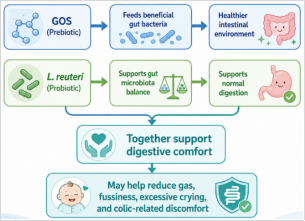
Galacto-oligosaccharides (GOS) and Lactobacillus reuteri are widely recognized for their potential role in supporting digestive comfort, particularly in infants and young children who experience colic-related symptoms. GOS are prebiotic fibers that serve as nourishment for beneficial gut bacteria, helping promote a healthier balance of intestinal microbiota. By encouraging the growth of friendly bacteria such as bifidobacteria, GOS may support smoother digestion, improve stool consistency, and contribute to overall gut comfort. L. reuteri, on the other hand, is a probiotic strain that may help restore microbial balance, support normal intestinal function, and reduce digestive discomfort associated with gas, bloating, and irregular gut movement. When used together, GOS and L. reuteri may offer complementary benefits: GOS helps feed beneficial bacteria, while L. reuteri helps introduce supportive probiotic activity into the gut
| [14] | Vandenplas, Y., et al. Limosilactobacillus reuteri DSM 17938-containing infant formulas and gastrointestinal tolerance. Nutrients, 2023. |
[14]
.
In cases of infant colic, digestive imbalance, gas accumulation, and immature gut function are often considered contributing factors. By supporting a balanced gut environment, these ingredients may help reduce excessive crying, fussiness, abdominal discomfort, and feeding-related unease. Their use can be especially helpful as part of a gentle nutritional approach designed to support digestive wellness. However, responses may vary from child to child, and these ingredients should be used according to age-appropriate guidance and healthcare professional recommendations
| [15] | Dupont, C., et al. Effect of L. reuteri on bowel movements in children aged 6 months to 4 years with functional constipation. JPGN Reports/Pediatric study, 2022. |
[15]
.
Key benefits may include:
a) Supports a healthy balance of gut microbiota.
b) Helps promote digestive comfort and tolerance.
c) May reduce gas, bloating, and abdominal discomfort.
d) Supports softer, more regular stool patterns.
e) May help reduce crying and fussiness linked with colic.
f) Offers complementary prebiotic and probiotic support.
4. The Science of Synbiotic GOS and L. Reuteri in Supporting Digestive Comfort with Regurgitation
Synbiotics combine prebiotics and probiotics to support a healthier gut environment. Galacto-oligosaccharides, commonly known as GOS, are prebiotic fibers that selectively nourish beneficial gut bacteria, while
Lactobacillus reuteri is a probiotic strain known for its role in supporting microbial balance and digestive function. When used together, GOS and
L. reuteri may provide complementary support for infants and young children experiencing digestive discomfort, including symptoms associated with regurgitation
| [17] | Schepper, J. D., et al. Gut microbiota in regulation of childhood bone growth. Experimental Physiology, 2024. |
[17]
.
Regurgitation is common in early infancy and often occurs because the digestive system is still developing. The lower esophageal sphincter, which helps prevent stomach contents from flowing back upward, may not yet function fully, allowing milk to return from the stomach into the esophagus. While mild regurgitation is usually normal, frequent spit-up can be associated with feeding discomfort, fussiness, gas, bloating, and unsettled behavior
| [18] | Zaiss, M. M., et al. Modulation of bone remodeling by the gut microbiota. Bone Research, 2023. |
[18]
.
GOS may help by promoting the growth of beneficial bacteria, especially bifidobacteria, which are naturally dominant in the healthy infant gut. A more balanced gut microbiota may support smoother digestion, better stool consistency, and reduced intestinal gas.
L. reuteri may further support digestive comfort by helping maintain a favorable microbial balance and supporting normal gut motility. Improved motility may help the stomach empty more efficiently, which can reduce the likelihood of milk remaining in the stomach for long periods and flowing back upward
| [19] | Wang, Y., et al. Gut microbiota modulation in osteoporosis: probiotics, prebiotics, and gut-bone axis mechanisms. Metabolites, 2025. |
[19]
.
Together, GOS and L. reuteri may help create a more comfortable digestive environment. Their synbiotic action supports gut balance, digestion, stool regularity, and feeding tolerance. For infants with regurgitation-related discomfort, this may contribute to reduced fussiness, less gas, and improved overall comfort after feeding. However, individual responses can vary, and persistent or severe regurgitation should always be discussed with a healthcare professional to rule out reflux disease, allergy, or other medical concerns.
5. The Science of Synbiotic GOS and L. Reuteri in Supporting Muscle and Bone Development
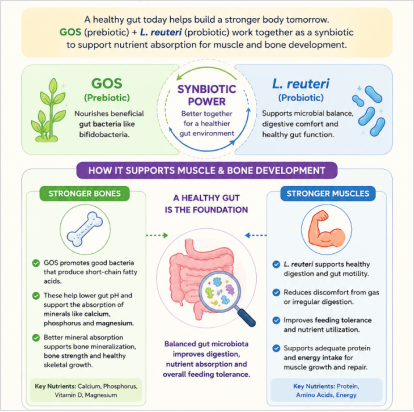
Muscle and bone development during infancy and early childhood depends on adequate nutrition, efficient nutrient absorption, healthy digestion, and a balanced gut environment. Synbiotics, which combine prebiotics and probiotics, may play a supportive role in this process by helping create conditions that improve digestive tolerance and nutrient utilization. Galacto-oligosaccharides, commonly known as GOS, are prebiotic fibers that nourish beneficial gut bacteria, while
Lactobacillus reuteri is a probiotic strain known for supporting microbial balance and normal digestive function. Together, GOS and
L. reuteri may contribute to a healthier intestinal environment that supports the body’s ability to use nutrients important for growth
| [21] | Qian, J., Fang, Z., Chang, S., et al. Effectiveness and safety study of formula containing probiotics, prebiotics, synbiotics on full-term infants’ growth: a systematic review and meta-analysis of randomized controlled studies. European Journal of Clinical Nutrition, 2025. |
[21]
.
Bone development relies heavily on nutrients such as calcium, phosphorus, vitamin D, magnesium, and protein. A balanced gut microbiota may support the absorption and availability of some of these nutrients. GOS may help by encouraging the growth of beneficial bacteria, especially bifidobacteria, which can produce short-chain fatty acids. These compounds may lower intestinal pH, creating an environment that can support mineral solubility and absorption, including calcium. Better calcium availability is important for bone mineralization, bone strength, and skeletal growth during early life
| [22] | Ma, O., Dutta, A., Bliss, D. W., Nakatsu, C. H., Weaver, C. M., & Whisner, C. M. Identifying gut microbiome features that predict responsiveness toward a prebiotic capable of increasing calcium absorption: a pilot study. Calcified Tissue International, 2024. |
[22]
.
Muscle development also depends on proper protein intake, amino acid availability, energy metabolism, and overall feeding tolerance. When digestion is comfortable, infants and children may feed more effectively and maintain better nutrient intake. L. reuteri may support digestive comfort by helping maintain microbial balance, promoting normal gut motility, and reducing discomfort related to gas or irregular digestion. This may indirectly support consistent feeding patterns, which are important for supplying protein and energy needed for muscle growth.
The synbiotic combination of GOS and L. reuteri may therefore support growth by working through the gut. GOS helps feed beneficial bacteria, while L. reuteri contributes probiotic activity that supports gut balance and digestive function. Together, they may help improve nutrient tolerance, mineral absorption, stool regularity, and overall digestive comfort.
Although synbiotics are not a replacement for essential nutrients, they may complement a balanced diet or age-appropriate nutrition plan by supporting the digestive environment where nutrient absorption begins. For muscle and bone development, adequate intake of calcium, vitamin D, protein, and other growth-supporting nutrients remains essential. Individual needs may vary, so parents and caregivers should seek healthcare professional guidance when choosing products for infants or young children.
6. Building Strong Foundations Through Gut Health in Early Life
Future nutritional approaches should focus on the connection between gut health, nutrient absorption, and healthy growth. Synbiotic combinations such as GOS and
L. reuteri may support a balanced gut microbiota, helping create a digestive environment where key nutrients like calcium, phosphorus, vitamin D, protein, and amino acids can be better tolerated and utilized. This makes digestive comfort an important part of supporting muscle and bone development during early growth stages
| [24] | Britton, R. A., Irwin, R., Quach, D., et al. Probiotic Lactobacillus reuteri prevents post-antibiotic bone loss by reducing intestinal dysbiosis and inflammation. Journal/PMC article, 2019. |
[24]
.
7. Practical Direction for Parents and Caregivers for Supporting Early Life Gut Health
The next step is to integrate synbiotic support as part of a complete, age-appropriate nutrition plan rather than viewing it as a standalone solution. Parents and caregivers should prioritize balanced feeding, adequate intake of bone- and muscle-supporting nutrients, regular growth monitoring, and professional guidance when choosing products for infants or young children. Continued education and research can help clarify how GOS and
L. reuteri contribute to long-term digestive comfort, nutrient utilization, and healthy physical development
| [25] | Li, K., Wang, X., et al. Gut microbiota and calcium balance. Frontiers in Microbiology, 2022. |
[25]
.
8. Conclusion
Synbiotic GOS and L. reuteri represent a promising nutritional approach for supporting healthy muscle and bone development through the gut. During infancy and early childhood, growth depends not only on the intake of essential nutrients but also on how well the body digests, absorbs, and utilizes them. GOS, a prebiotic fiber, helps nourish beneficial gut bacteria, particularly bifidobacteria, while L. reuteri, a probiotic strain, supports microbial balance, digestive comfort, and normal gut function. Together, they may help create a healthier intestinal environment that supports nutrient tolerance and absorption.
Bone development requires a steady supply of calcium, phosphorus, vitamin D, magnesium, and protein. A balanced gut microbiota may support mineral availability by producing short-chain fatty acids, which can help maintain a favorable intestinal environment for mineral absorption. In this way, GOS may indirectly contribute to bone mineralization, skeletal growth, and bone strength. At the same time, L. reuteri may support gut motility and reduce digestive discomfort such as gas or irregular digestion, helping infants and children feed more comfortably and consistently.
Muscle development also depends on adequate protein, amino acids, energy intake, and overall nutritional balance. When digestion is comfortable and feeding tolerance is improved, children are more likely to receive the nutrients needed for muscle growth, repair, and strength. The synbiotic action of GOS and L. reuteri may therefore support both digestive wellness and growth-related outcomes.
However, synbiotics should not be viewed as a replacement for essential nutrients or medical care. They work best as part of a complete, age-appropriate nutrition plan that includes balanced feeding, adequate micronutrient intake, and regular growth monitoring. With appropriate healthcare professional guidance, GOS and L. reuteri may help build a stronger foundation for digestive comfort, nutrient utilization, healthy bones, and developing muscles.
Author Contributions
SK Sadek Ali: Conceptualization, Formal Analysis, Investigation, Methodology, Project administration, Supervision, Validation, Writing – original draft, Writing – review & editing
KM Mahbubur Rahman: Conceptualization, Data curation, Formal Analysis, Investigation, Methodology, Project administration, Visualization
ANM Tanvir Chowdhury: Conceptualization, Data curation, Formal Analysis, Investigation, Methodology, Project administration, Visualization
Tapan Chandra Roy: Conceptualization, Data curation, Formal Analysis, Investigation, Methodology, Project administration, Visualization
Jannatul Ferdous: Conceptualization, Data curation, Formal Analysis, Investigation, Validation, Visualization, Writing – original draft
Shahidur Rahman Chowdhury: Conceptualization, Data curation, Formal analysis, Investigation, Methodology, Project administration, Supervision, Validation, Visualization, Writing – original draft, Writing – review & editing
Washim Bari: Conceptualization, Data curation, Formal analysis, Investigation, Methodology, Project administration
Conflicts of Interest
The authors declare no conflicts of interest.
References
| [1] |
Sanz, M. L., et al. Galactooligosaccharides: physiological benefits, production strategies, and applications. Biotechnology Advances, 2022.
|
| [2] |
Whisner, C. M., et al. Galacto-oligosaccharides increase calcium absorption and gut bifidobacteria in young girls. British Journal of Nutrition, 2013.
|
| [3] |
Weaver, C. M. Galacto-oligosaccharides: prebiotic effects on calcium absorption and bone health. Springer, 2012.
|
| [4] |
Hsieh, S. A., et al. Effects of infant formula supplemented with prebiotics on gut microbiota, growth, safety, and tolerance. Nutrition Reviews, 2024.
|
| [5] |
Tandon, D., et al. The effect of prebiotic fortified infant formulas on microbiota composition. Scientific Reports, 2019.
|
| [6] |
Knol, J., et al. Infant formula containing galacto- and fructo-oligosaccharides and gut microbiota modulation. British Journal of Nutrition, 2005/related review.
|
| [7] |
Sajdel-Sulkowska, E. M., et al. Early-life gut microbiota profiles linked to synbiotic formula effects. American Journal of Clinical Nutrition, 2022.
|
| [8] |
Vandenplas, Y., et al. Modulating the early-life gut microbiota using pro-, pre-, and synbiotics. Nutrition Reviews, 2024.
|
| [9] |
Savino, F., et al. Lactobacillus reuteri DSM 17938 in infantile colic: a randomized, double-blind, placebo-controlled trial. Pediatrics, 2010.
|
| [10] |
Sung, V., et al. Lactobacillus reuteri to treat infant colic: a meta-analysis. Pediatrics, 2018.
|
| [11] |
Xu, M., et al. The efficacy and safety of Lactobacillus reuteri DSM 17938 for infantile colic: a meta-analysis. PLOS ONE, 2015.
|
| [12] |
Indrio, F., et al. Lactobacillus reuteri accelerates gastric emptying and improves regurgitation in infants. European Journal of Clinical Investigation, 2011.
|
| [13] |
Salvatore, S., et al. Effect of partially hydrolysed whey infant formula supplemented with L. reuteri DSM 17938 on gastric emptying and regurgitation. Nutrients, 2017.
|
| [14] |
Vandenplas, Y., et al. Limosilactobacillus reuteri DSM 17938-containing infant formulas and gastrointestinal tolerance. Nutrients, 2023.
|
| [15] |
Dupont, C., et al. Effect of L. reuteri on bowel movements in children aged 6 months to 4 years with functional constipation. JPGN Reports/Pediatric study, 2022.
|
| [16] |
Yan, J., et al. Gut microbiota-mediated regulation of skeletal development: a review. Journal/ScienceDirect Review, 2025.
|
| [17] |
Schepper, J. D., et al. Gut microbiota in regulation of childhood bone growth. Experimental Physiology, 2024.
|
| [18] |
Zaiss, M. M., et al. Modulation of bone remodeling by the gut microbiota. Bone Research, 2023.
|
| [19] |
Wang, Y., et al. Gut microbiota modulation in osteoporosis: probiotics, prebiotics, and gut-bone axis mechanisms. Metabolites, 2025.
|
| [20] |
Fu, X., et al. Targeting gut microbiota in osteoporosis: impact of microbial-based functional food ingredients. Journal of Advanced Research, 2023.
|
| [21] |
Qian, J., Fang, Z., Chang, S., et al. Effectiveness and safety study of formula containing probiotics, prebiotics, synbiotics on full-term infants’ growth: a systematic review and meta-analysis of randomized controlled studies. European Journal of Clinical Nutrition, 2025.
|
| [22] |
Ma, O., Dutta, A., Bliss, D. W., Nakatsu, C. H., Weaver, C. M., & Whisner, C. M. Identifying gut microbiome features that predict responsiveness toward a prebiotic capable of increasing calcium absorption: a pilot study. Calcified Tissue International, 2024.
|
| [23] |
Subramanian, S., Huq, S., Yatsunenko, T., Haque, R., Mahfuz, M., Alam, M. A., Benezra, A., DeStefano, J., Meier, M. F., Muegge, B. D., Barratt, M. J., VanArendonk, L. G., Zhang, Q., Province, M. A., Petri, W. A., Jr., Ahmed, T., & Gordon, J. I. (2014). Persistent gut microbiota immaturity in malnourished Bangladeshi children. Nature, 510(7505), 417–421.
|
| [24] |
Britton, R. A., Irwin, R., Quach, D., et al. Probiotic Lactobacillus reuteri prevents post-antibiotic bone loss by reducing intestinal dysbiosis and inflammation. Journal/PMC article, 2019.
|
| [25] |
Li, K., Wang, X., et al. Gut microbiota and calcium balance. Frontiers in Microbiology, 2022.
|
Cite This Article
-
APA Style
Ali, S. S., Rahman, K. M., Chowdhury, A. T., Roy, T. C., Ferdous, J., et al. (2026). The Science of Synbiotic GOS and L. Reuteri in Digestive Comfort, Reducing Colic-Related Symptoms, Regurgitation, and Advancing Muscle and Bone Development. International Journal of Nutrition and Food Sciences, 15(4), 171-177. https://doi.org/10.11648/j.ijnfs.20261504.13
 Copy
|
Copy
|
 Download
ACS Style
Ali, S. S.; Rahman, K. M.; Chowdhury, A. T.; Roy, T. C.; Ferdous, J., et al. The Science of Synbiotic GOS and L. Reuteri in Digestive Comfort, Reducing Colic-Related Symptoms, Regurgitation, and Advancing Muscle and Bone Development. Int. J. Nutr. Food Sci. 2026, 15(4), 171-177. doi: 10.11648/j.ijnfs.20261504.13
Copy
|
Download
AMA Style
Ali SS, Rahman KM, Chowdhury AT, Roy TC, Ferdous J, et al. The Science of Synbiotic GOS and L. Reuteri in Digestive Comfort, Reducing Colic-Related Symptoms, Regurgitation, and Advancing Muscle and Bone Development. Int J Nutr Food Sci. 2026;15(4):171-177. doi: 10.11648/j.ijnfs.20261504.13
Copy
|
Download
-
@article{10.11648/j.ijnfs.20261504.13,
  author = {SK Sadek Ali and KM Mahbubur Rahman and ANM Tanvir Chowdhury and Tapan Chandra Roy and Jannatul Ferdous and Shahidur Rahman Chowdhury and Washim Bari and ASM Selim},
  title = {The Science of Synbiotic GOS and L. Reuteri in Digestive Comfort, Reducing Colic-Related Symptoms, Regurgitation, and Advancing Muscle and Bone Development},
  journal = {International Journal of Nutrition and Food Sciences},
  volume = {15},
  number = {4},
  pages = {171-177},
  doi = {10.11648/j.ijnfs.20261504.13},
  url = {https://doi.org/10.11648/j.ijnfs.20261504.13},
  eprint = {https://article.sciencepublishinggroup.com/pdf/10.11648.j.ijnfs.20261504.13},
  abstract = {Synbiotic nutrition, which combines prebiotics and probiotics, has gained increasing attention for its potential role in supporting digestive comfort, gut health, and healthy development during infancy and early childhood. The gastrointestinal tract of infants is still developing, and the establishment of a balanced intestinal microbiota is an important part of this process. During this period, digestive symptoms such as colic, excessive crying, fussiness, gas-related discomfort, irregular stool patterns, and regurgitation are common concerns for parents and caregivers. Nutritional strategies that support a healthy gut environment may therefore provide meaningful benefits. Galacto-oligosaccharides (GOS) are well-recognized prebiotics that selectively stimulate the growth and activity of beneficial intestinal bacteria, particularly bifidobacteria. By promoting a microbiota composition associated with a healthier intestinal environment, GOS may contribute to improved stool consistency, regularity, and overall digestive tolerance. A bifidobacteria-rich microbiota may also support the maturation of intestinal function and help maintain an appropriate balance between beneficial and potentially harmful microorganisms. Limos lactobacillus reuteri is a probiotic species that has been widely studied in relation to gastrointestinal health. It may support gut microbial balance, intestinal barrier function, and digestive comfort. Evidence suggests that L. reuteri may help improve gastrointestinal motility and reduce symptoms associated with infant colic, including excessive crying and fussiness. It may also play a role in reducing gas-related discomfort and regurgitation by supporting a more stable intestinal environment and better digestive function. When combined, GOS and L. reuteri may provide complementary or synergistic benefits. GOS can create a favorable environment for beneficial bacteria, while L. reuteri may contribute directly to microbial balance and gastrointestinal function. Together, they may support stool regularity, reduce digestive discomfort, and improve tolerance during early childhood. This combined approach may be particularly relevant during periods when the digestive system is still immature. Beyond digestive comfort, improved gut health may support nutrient digestion and absorption. Better utilization of protein, calcium, and other minerals is important for muscle strength, bone development, and physical growth. Adequate nutrient absorption during infancy and early childhood contributes to healthy musculoskeletal development and overall well-being. This review discusses the scientific basis for the combined use of GOS and L. reuteri in early childhood nutrition, with emphasis on digestive comfort, colic-related symptoms, regurgitation, nutrient utilization, and musculoskeletal development.},
 year = {2026}
}
Copy
|
Download
-
TY  - JOUR
T1  - The Science of Synbiotic GOS and L. Reuteri in Digestive Comfort, Reducing Colic-Related Symptoms, Regurgitation, and Advancing Muscle and Bone Development
AU  - SK Sadek Ali
AU  - KM Mahbubur Rahman
AU  - ANM Tanvir Chowdhury
AU  - Tapan Chandra Roy
AU  - Jannatul Ferdous
AU  - Shahidur Rahman Chowdhury
AU  - Washim Bari
AU  - ASM Selim
Y1  - 2026/07/27
PY  - 2026
N1  - https://doi.org/10.11648/j.ijnfs.20261504.13
DO  - 10.11648/j.ijnfs.20261504.13
T2  - International Journal of Nutrition and Food Sciences
JF  - International Journal of Nutrition and Food Sciences
JO  - International Journal of Nutrition and Food Sciences
SP  - 171
EP  - 177
PB  - Science Publishing Group
SN  - 2327-2716
UR  - https://doi.org/10.11648/j.ijnfs.20261504.13
AB  - Synbiotic nutrition, which combines prebiotics and probiotics, has gained increasing attention for its potential role in supporting digestive comfort, gut health, and healthy development during infancy and early childhood. The gastrointestinal tract of infants is still developing, and the establishment of a balanced intestinal microbiota is an important part of this process. During this period, digestive symptoms such as colic, excessive crying, fussiness, gas-related discomfort, irregular stool patterns, and regurgitation are common concerns for parents and caregivers. Nutritional strategies that support a healthy gut environment may therefore provide meaningful benefits. Galacto-oligosaccharides (GOS) are well-recognized prebiotics that selectively stimulate the growth and activity of beneficial intestinal bacteria, particularly bifidobacteria. By promoting a microbiota composition associated with a healthier intestinal environment, GOS may contribute to improved stool consistency, regularity, and overall digestive tolerance. A bifidobacteria-rich microbiota may also support the maturation of intestinal function and help maintain an appropriate balance between beneficial and potentially harmful microorganisms. Limos lactobacillus reuteri is a probiotic species that has been widely studied in relation to gastrointestinal health. It may support gut microbial balance, intestinal barrier function, and digestive comfort. Evidence suggests that L. reuteri may help improve gastrointestinal motility and reduce symptoms associated with infant colic, including excessive crying and fussiness. It may also play a role in reducing gas-related discomfort and regurgitation by supporting a more stable intestinal environment and better digestive function. When combined, GOS and L. reuteri may provide complementary or synergistic benefits. GOS can create a favorable environment for beneficial bacteria, while L. reuteri may contribute directly to microbial balance and gastrointestinal function. Together, they may support stool regularity, reduce digestive discomfort, and improve tolerance during early childhood. This combined approach may be particularly relevant during periods when the digestive system is still immature. Beyond digestive comfort, improved gut health may support nutrient digestion and absorption. Better utilization of protein, calcium, and other minerals is important for muscle strength, bone development, and physical growth. Adequate nutrient absorption during infancy and early childhood contributes to healthy musculoskeletal development and overall well-being. This review discusses the scientific basis for the combined use of GOS and L. reuteri in early childhood nutrition, with emphasis on digestive comfort, colic-related symptoms, regurgitation, nutrient utilization, and musculoskeletal development.
VL  - 15
IS  - 4
ER  -
Copy
|
Download

 ,
KM Mahbubur Rahman
,
KM Mahbubur Rahman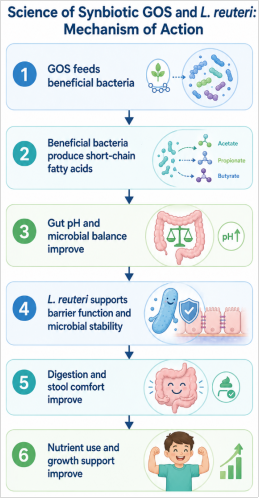




 Share This Article
 Twitter
 Linked In
 Facebook